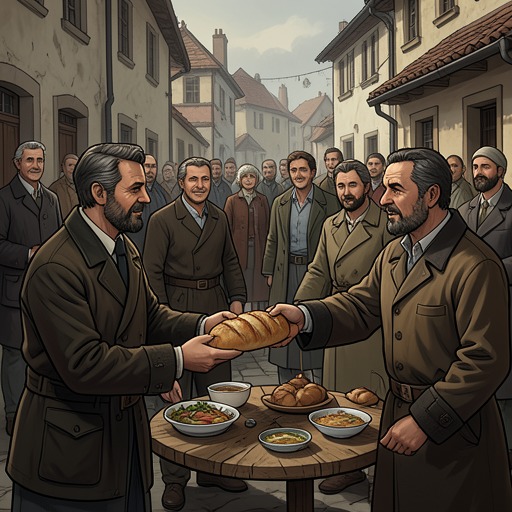
Ghino di Tacco
The DecameronGhino di Tacco is a feared outlaw whose capture of the Abbot of Cluny becomes a test of character—and a turning point in his own life. Instead of stripping his captive of everything, Ghino tends the abbot’s stomach ailment and returns his possessions at his discretion. The abbot, moved by this unexpected generosity, secures Ghino’s reconciliation with Pope Boniface VIII and his appointment as a knight and prior of the Knights Hospitaller.
Identity and Outlawry
The story introduces Ghino as a man famous for cruelty and robbery. Expelled from Siena and at feud with the Counts of Santa Fiore, he establishes himself at Radicofani, where his men plunder travelers passing through the surrounding country. His resistance to the Roman Church’s authority is part of the political setting: the narrative presents him not as a harmless wanderer but as a powerful outlaw whose stronghold makes the roads dangerous.
Yet the tale later complicates that public reputation. When Ghino explains his past to the abbot, he says that he was a gentleman driven from his home, left poor, and surrounded by powerful enemies. In his account, these circumstances—not an evil disposition—drove him to robbery as a means of defending his life and noble standing. This is his own explanation, not an independent account of his expulsion, but it gives the abbot a reason to see the outlaw as more than the sum of his crimes.
The Abbot’s Capture and Treatment
When the wealthy Abbot of Cluny travels toward the baths of Siena on his physicians’ advice, Ghino hears of his approach and surrounds him and his entire household in a narrow place. No servant escapes. Ghino’s messenger asks the abbot to dismount and stay at the castle; after the abbot refuses, armed men close around the party, leaving him no choice but to go.
The capture is coercive, but Ghino does not treat the whole party alike. He places the abbot alone in a dark, mean chamber, while the rest of the household is lodged according to rank. The horses and baggage are secured without being touched. Ghino then asks, courteously, where the abbot was going and why. Once he learns about the stomach complaint and the intended visit to the baths, he resolves to treat it himself.
His remedy begins with a fire kept burning in the abbot’s small room and a carefully served meal: two slices of toasted bread and a large beaker of Ghino’s own wine. Ghino presents these as the beginning of a treatment he learned while studying medicine as a young man. He brings the same bread and wine the following day, and continues for several days. The abbot, at first hungry and resentful, eats despite his reluctance. Ghino also has dried beans secretly brought in and left where the abbot can find them. After the abbot eats some, Ghino asks how his stomach feels; the captive replies that the remedies have worked and that his chief wish is to be out of Ghino’s hands.
Release and the Choice of Ransom
Once Ghino judges that the abbot has recovered, the conditions of his captivity change. He has the abbot’s own people prepare a fine chamber with the abbot’s belongings, and arranges a magnificent banquet for the prelate’s household and many people from the town. For several days the abbot and his attendants are served well. The abbot tells his men what life in captivity has been like; they report that Ghino has treated them remarkably well.
Only after this period does Ghino reveal himself fully and offer the abbot a choice. He brings him to a hall where the baggage has been assembled and points out the horses in the courtyard, including the poorest one. He explains that he will not take the share of the abbot’s goods that he might ordinarily demand from a captive. Instead, the abbot may decide whether Ghino receives a part or all of the property, and may leave or stay as he wishes. The gesture does not undo the abduction, but it reverses the expected logic of robbery: the man who has all the power places the decision over the ransom in his prisoner’s hands.
The abbot responds by embracing Ghino and choosing to take only a few necessary possessions and horses, leaving the rest behind. His anger gives way to goodwill. He regards Ghino’s generosity as evidence that the outlaw possesses worth that his criminal life conceals, and the two become friends.
Reconciliation and Change of Status
Back at Rome, Pope Boniface VIII asks the returning abbot how the baths helped him. The abbot answers that a worthy physician nearer at hand cured him, then recounts what happened. He asks the Pope to restore Ghino to favor, arguing that the outlaw’s wrongful trade arose more from fortune than from character and that support suited to Ghino’s station could give him another way to live.
The Pope agrees to act if the abbot’s judgment proves sound and instructs him to summon Ghino in safety. Ghino comes to court under that assurance. The Pope comes to regard him as a worthy man, takes him into favor, has him made a knight of the Knights Hospitaller, and grants him a grand priory. Ghino holds the office for the rest of his life and, according to the story, proves a loyal friend and servant of the Church and of the Abbot of Cluny.
Narrative Significance
Ghino’s story turns on a contrast between reputation and conduct. He begins as a robber whose followers prey on travelers, yet in the decisive episode he preserves the abbot’s household and property, nurses his captive, and lets him determine the payment. The abbot’s judgment then transforms private gratitude into public rehabilitation: Ghino’s act gives him an advocate at the papal court and a path from outlawry to recognized service.
Told within the Decameron’s account of magnanimity, the episode also makes an outlaw’s generosity more striking by setting it against the expectation that churchmen are ungenerous and eager for vengeance. Ghino’s rehabilitation is not presented as the result of a formal trial or a denial of his robberies. It follows from a particular encounter in which both men change their view of the other: the abbot recognizes worth in his captor, and Ghino responds to that recognition by accepting a life in the service of the Church.